Give every companion one automatic job
You control the main hero directly, while companions act from their own visible conditions. Equip each companion for one role that remains valuable without manual timing: steady damage, armor pressure, finishing, healing, buffs, or durable support. A simple repeatable role produces more value than a board of conditional effects that never align.
Keep the main hero responsible for shaping the fight. Create one priority target, open its armor or lower its health, and let companions contribute to that same outcome. Default companion attacks tend toward low-health enemies, so concentrated player pressure gives the party a clear enemy to finish instead of scattering actions.
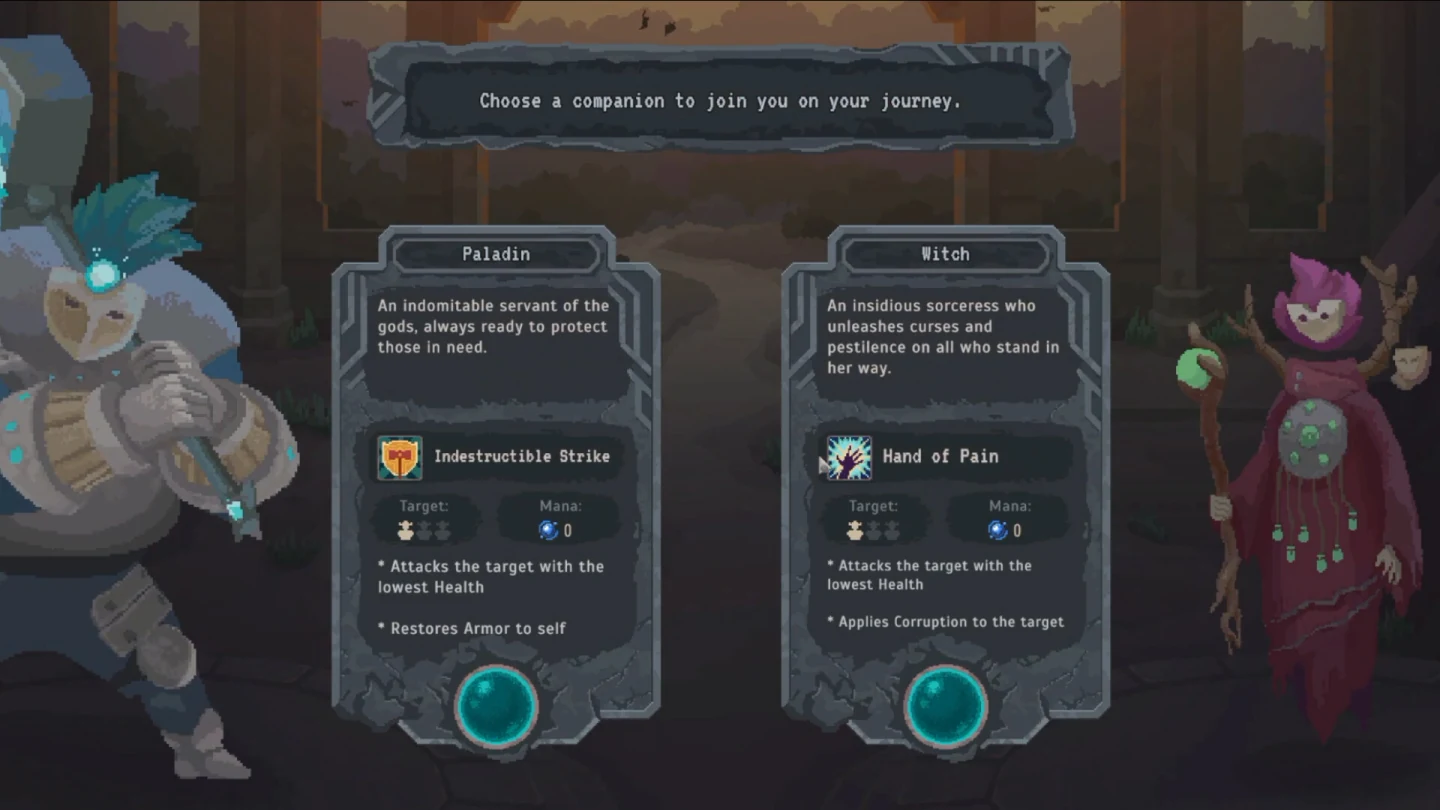
Build companion grids around triggers that occur consistently
Read each companion action and equip gear that supports the condition shown in the current interface. A trigger is useful only when the party can create it repeatedly. Avoid filling cells with effects that depend on exact manual timing, because the player cannot choose every companion action. Compact items and clear aura contacts make automatic roles easier to maintain.
Place the companion's defining item first, add the contact that strengthens it, then add enough survival for the role to continue. Do not give every companion a weaker copy of the hero's damage plan. Separate inventories exist so one character can open armor, another can support, and another can finish health without competing for the same cells.
| Role | What the grid must do | Main hero contribution |
|---|---|---|
| Finisher | Produce reliable damage on exposed targets | Create one low-health target |
| Armor pressure | Apply Crush or another armor answer | Follow with health pressure |
| Support | Trigger buffs, healing, or protection reliably | Keep threats focused away from it |
| Durable utility | Survive while repeating its effect | Spend mana when its loss breaks the plan |
Align target focus with automatic behavior
At the start of each round, identify the enemy whose next action creates the greatest loss. Use the main hero to bring that enemy into the state companions can exploit. If the party finishes low-health targets, avoid leaving several enemies at similar health. If a companion opens armor, allow that action to occur before committing Slash pressure.
Recalculate after every defeat or major enemy action. Automatic behavior becomes reliable when the combat state offers one obvious high-value outcome. It becomes wasteful when the hero spreads setup across several enemies or changes lanes before the first threat is removed.
- Choose the most dangerous upcoming enemy action.
- Prepare that enemy for the party's automatic roles.
- Commit the hero and companions until the threat is removed.
- Select the next target only after the first action disappears.
Protect the role whose loss breaks the party
Not every companion has equal value in every build. Identify which loss removes healing, buffs, armor handling, or finishing damage. Spend mana or target an enemy earlier when that action keeps the essential companion contributing. This is especially important for the no-companion-death challenge, but it also improves ordinary boss consistency.
Durability should support the role rather than replace it. A companion that survives but no longer produces useful actions occupies a grid without advancing the encounter. Add the minimum defense needed to preserve its loop, then return remaining cells to the effect that defines the job.
- Protect the only armor answer before duplicated damage.
- Protect repeatable support when it keeps multiple characters active.
- Remove the enemy action that threatens the essential role.
- Keep enough damage to end the fight after stabilizing.
Fix a party that acts without accomplishing anything
If companions attack different enemies, create one clear finishing target with the hero. If triggers rarely occur, simplify each grid and keep only effects tied to a repeatable condition. If the party cannot handle armor, assign that lane to one character rather than diluting every grid. If a support companion dies early, improve its survival and Initiative relationship before adding more secondary bonuses.
A complete party remains readable during combat: the hero chooses the threat, one role opens the target, another sustains or protects the team, and concentrated damage removes the action. When every grid has a distinct purpose, automatic companions become predictable tools instead of uncontrolled extra turns.