Treat auto-rotation as an item rule, not a bug
Use the tooltip to identify whether a Divine item carries the auto-rotation rule. Not every Divine item rotates. For those that do, the orientation changes every turn by design. Plan the grid around every orientation the shape will occupy instead of arranging only the position visible when the item first drops.
If the item cannot rotate without breaking the contacts that make it valuable, skip it or rebuild a buffer around it. The correct comparison is the item's repeatable value across the whole rotation cycle, not its best single orientation. A powerful tooltip does not justify a board that fails every other turn.
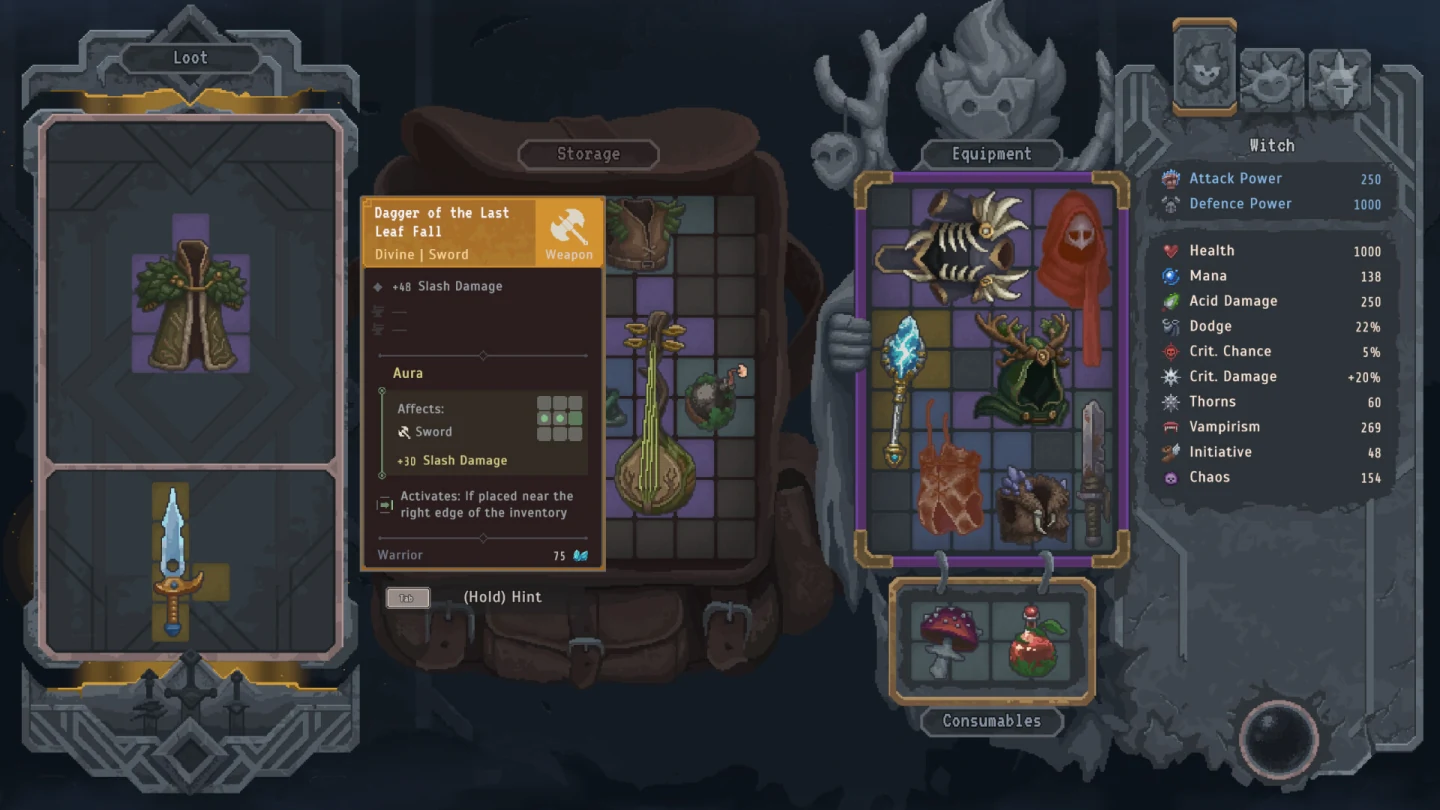
Map the rotation envelope before confirming the layout
Place the Divine item in an open area and rotate it through the full set of shapes or orientations shown by the interface. Mark the union of every cell it occupies. That union is the real space cost. Keep essential anchors, rings, and receivers outside cells the item will need later.
Square pieces are mechanically easier because rotating a square does not change its occupied footprint, even though the rule still advances. Long and irregular pieces need more clearance. Put those near a boundary only when every rotation remains valid; an edge can reduce interference, but it can also remove an orientation the item requires.
- Read the auto-rotation line on the current tooltip.
- Cycle through every available orientation before filling neighboring cells.
- Reserve the complete occupied-cell envelope.
- Place permanent anchors outside that envelope.
- Confirm useful contacts in the weakest orientation.
Keep only contacts that survive the cycle
A contact that exists for one orientation and disappears on the next is a temporary bonus. Build around persistent contacts first. If a ring or aura can touch the Divine item through every orientation, that relationship is dependable. If the contact changes, treat the extra value as a bonus rather than the foundation of the character's role.
The same rule applies when the Divine item provides an aura. Identify which neighboring cells remain adjacent through the cycle and place the most important receiver there. Avoid putting the only damage item on a contact that regularly disappears. Companion grids especially benefit from stable relationships because their combat choices are automatic.
| Contact type | How to value it |
|---|---|
| Active in every orientation | Safe foundation for the build |
| Active in most orientations | Useful secondary value |
| Active in one orientation | Occasional bonus only |
| Blocks a required rotation | Remove or relocate it |
Know when to skip a rotating Divine item
Skip the item when its rotation envelope removes several working aura contacts, when the grid has no clean buffer, or when the effect duplicates a role already covered. Also skip it late in a run if the rebuild would consume the time and flexibility needed for the next boss. Rarity is not compensation for unreliable positioning.
Take it when the board is still open, the item becomes a clear new anchor, or a square footprint provides its effect without changing the occupied cells. A compact party grid can also accept it when the rotating relationship is nonessential and the base item remains strong in every orientation.
- Take: open board and clear role.
- Take: stable footprint or stable critical contacts.
- Skip: rotation breaks the primary engine.
- Skip: the effect is only better in one temporary orientation.
Repair the board after a bad Divine pickup
Remove nearby filler and test the full cycle again. If the item can operate with a clean envelope, rebuild the best persistent contact first and add secondary gear afterward. If it still collides with the character's anchor, move the Divine item to a companion whose role and grid can accept it.
When neither grid can preserve a complete role, discard the new plan and restore the previous engine. The decision is not a failure to use rare loot; it is correct inventory management. Divine items are strongest when their special behavior becomes predictable inside the layout rather than forcing constant emergency rearrangement.