Each biome end presents two Guardian-part options
The current Steam Store calls the system and final boss the Guardian. Some current in-game UI, including the part-choice screen, labels that same final enemy Sentinel. This guide uses Guardian as the primary term; the names do not identify mechanically different systems.
Choose one of the two options presented at each biome end. All parts selected across biome-end choices contribute to the final Guardian's appearance and power. Keep a written or mental list of every selection so the final preparation reflects the complete run rather than only the most recent choice.
Use only the information visible in the selection interface. A part name, image, or description does not justify assigning a mechanic that the game does not display. When the selection does not explain a combat effect, keep the current build coherent and make the choice without rebuilding around an assumed interaction.
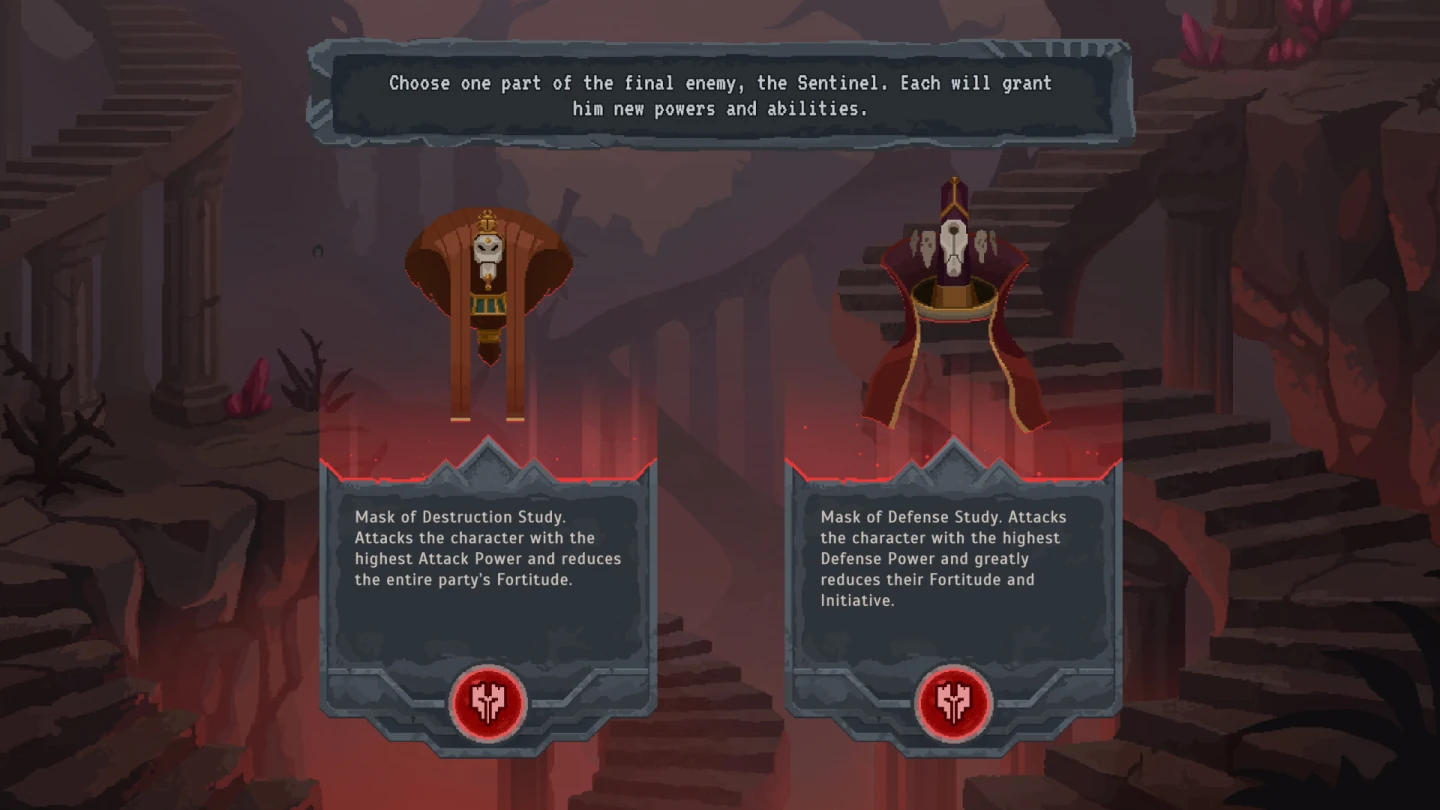
Audit the party's existing weaknesses before choosing
Check main damage, armor access, survival, companion reliability, mana, and grid flexibility before confirming a selection. This audit does not predict what a part does. It shows which weaknesses must be repaired before the final Guardian regardless of the option chosen.
Name the character responsible for each essential role. If the party has no armor answer, no focused health pressure, or one fragile companion carrying all support, make that gap the next reward priority. Preserve the anchor that already wins ordinary fights instead of replacing it immediately after a part selection.
- Read the visible information for both options.
- Record the selected part with earlier selections.
- Name the party's current damage, armor, and survival gaps.
- Keep connected inventory space for a later repair.
- Continue without assigning an effect the selection does not show.
Keep one focused final-Guardian plan
Corruption through a Witch direction, a successful Witch debuff build, fortitude-reduction powder, focused stat lanes, and sustain all appear in current final-Guardian strategy. Witch is not mandatory. Choose the approach already supported by the run and keep enough damage and survival for it to remain functional.
A Paladin can preserve hammer pressure and defense, a Warrior can keep focused offense or a durable loop, and a Bard can support the party sequence. Guardian-part selection does not require abandoning a working class plan when no displayed information calls for that change.
| Party layer | Check before continuing |
|---|---|
| Damage | One focused lane can still finish targets |
| Armor | One character can remove or bypass it |
| Companions | Every essential automatic role can survive |
| Mana | Boss resources are not spent in safe rooms |
| Grid | Connected cells remain for a real upgrade |
Review all accumulated selections before the final node
At every later biome end, add the new selection to the complete list. Do not reduce the run to a pair of parts or assume only the last two choices matter. All parts selected across biome-end choices are part of the final Guardian assembly shown by the game.
Before the final node, review the complete selection history and then run the generic party audit. Preserve the core layout, remove low-impact filler, protect the essential companion, and reserve mana. These actions prepare the party without inventing a part-effect table.
- Track every biome-end selection.
- Review the complete list before the final node.
- Repair existing party weaknesses with current rewards.
- Preserve the build's demonstrated win condition.
Recover from an uncertain selection
When the visible selection information does not indicate a clear combat consequence, choose without dismantling the build. Continue collecting flexible, role-focused upgrades and evaluate the final encounter from its visible combat state when it begins.
The useful decision is the one that preserves a coherent run: focused damage, an armor answer, sustainable companions, reserved mana, and room to adapt. Those checks remain valid across every selection and do not depend on a claimed hidden part mechanic.