Build one jewelry engine instead of collecting every ring
Use rings and amulets as multipliers for a focused equipment family, not as trophies that must all fit. Pick the weapon or armor type that already carries the character's damage or defense, then keep jewelry whose aura condition matches that type. A ring surrounded by unrelated pieces consumes cells without multiplying the part of the build that wins fights.
Start with one main character engine and one compact engine on each companion. The main grid can support the most demanding contact pattern because you control its combat decisions. Companion grids should favor jewelry that improves the gear they already use automatically. This division prevents a single awkward amulet from forcing three characters into the same item plan.
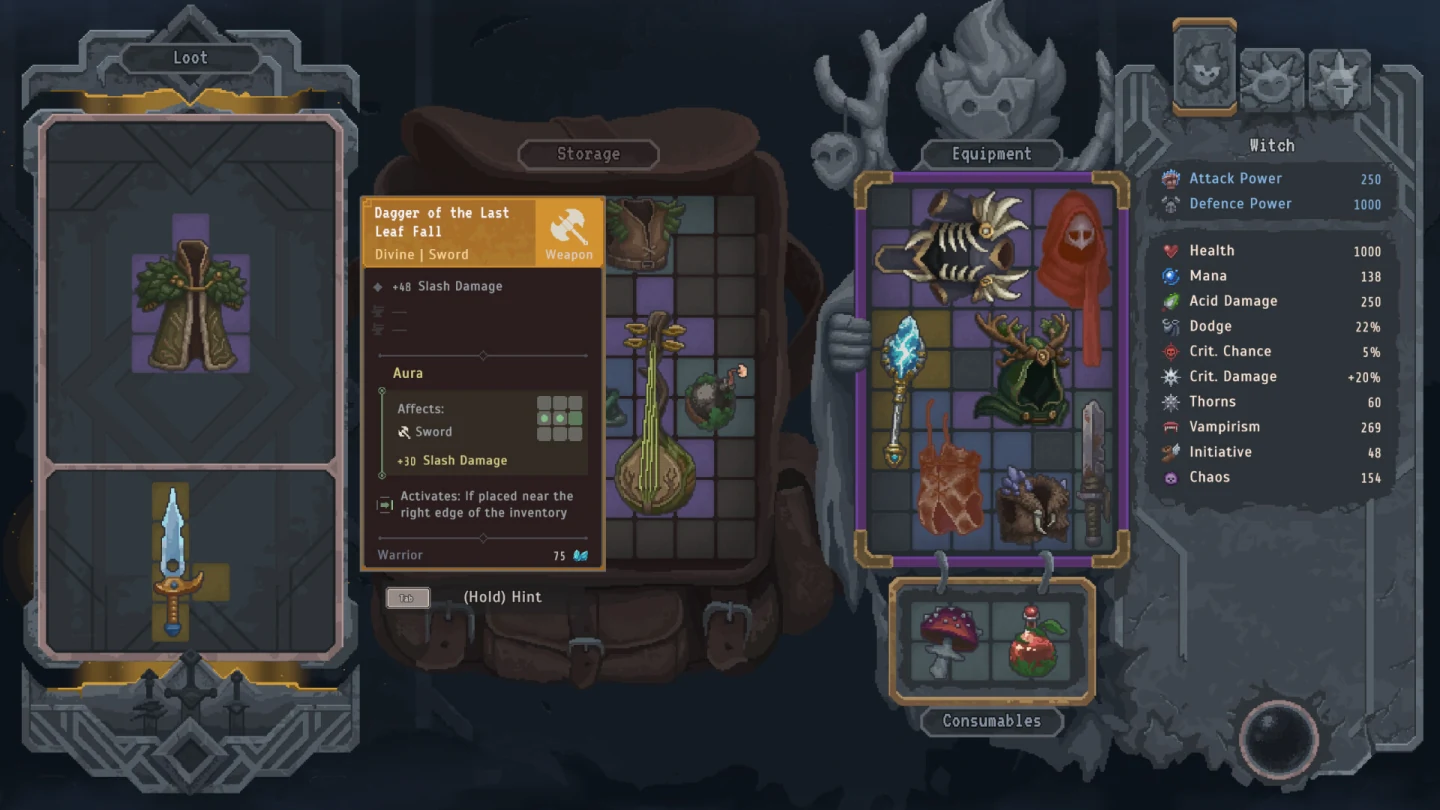
Place the ring before the items that receive its aura
Put the highest-value ring or amulet into a position with enough open edges for compatible gear. Then place the strongest receiver first. Small straight weapons, compact hammers, hats, or other matching pieces are valuable because they can touch the jewelry without sealing every remaining lane. Rotate each receiver through its practical orientations before adding the next one.
Do not count visual contact alone. Open the tooltip after placement and confirm that the condition names the equipped family you are using. If a receiver does not qualify, move it out of the contact zone even when the board looks tidy. Jewelry cells are premium cells; every neighbor should either gain the intended effect or protect the engine's survival.
- Choose the ring or amulet with the best match for the current role.
- Place the strongest compatible item on its easiest useful edge.
- Confirm the relationship in the current tooltip and stat display.
- Add compact matching items around the remaining useful edges.
- Leave one connected pocket for a future replacement.
Use three board tests before accepting more jewelry
The first test is contact value: count how many neighbors receive a bonus that matters to the character. The second is cell efficiency: compare the total cells occupied by the jewelry cluster with the damage, armor, healing, or support it creates. The third is replacement flexibility: identify whether one receiver can be swapped without dismantling the entire arrangement.
Reject a new ring when it duplicates an aura that is already saturated, demands an equipment family the character does not use, or divides the open grid into unusable islands. Accept it when it adds a second useful edge to an established family, turns several compact items into a larger combined gain, or lets a companion perform one automatic job more reliably.
| Question | Keep it when | Skip it when |
|---|---|---|
| Does the condition match? | Several equipped items qualify | The grid would need a new item family |
| Are the contacts efficient? | Useful receivers fit around open edges | One weak item occupies the only useful edge |
| Can the grid evolve? | A connected upgrade pocket remains | Every future swap requires a full rebuild |
Carry reserve pieces only when a reshuffle is realistic
A reserve item is useful when it can replace a current receiver after a rotation or when it preserves the same equipment family in a cleaner shape. Keep one or two realistic alternatives, not an entire second build. Too many reserve pieces make reward comparisons harder and encourage a late rebuild that lacks enough matching contacts.
Before entering a boss sequence, settle the jewelry engine and remove speculative pieces that do not have a destination. Use the freed decision space to check defense, mana, and companion durability. A completed aura engine still loses if the party cannot survive long enough to use it, so treat jewelry as the core multiplier rather than the complete plan.
- Keep a reserve when its shape fixes a known gap.
- Keep a reserve when it preserves the same aura family.
- Drop a reserve when installing it would break more contacts than it creates.
- Drop a reserve when the next major fight needs survival instead.
Repair a ring layout that has stopped scaling
Remove every neighbor that does not qualify for the ring or does not support the character's job. Rebuild the best jewelry-receiver pair first, then compare each additional item by the value it creates per occupied cell. If a large piece blocks two stronger contacts, move it to another grid or replace it with compact matching gear.
The finished layout should be easy to explain: this jewelry piece strengthens this equipment family, these receivers provide the role, and this open pocket accepts an upgrade. If the explanation requires several unrelated bonuses and exceptions, simplify. Rings and amulets become powerful through repeated relevant contacts, not through the number of rare labels on the board.